
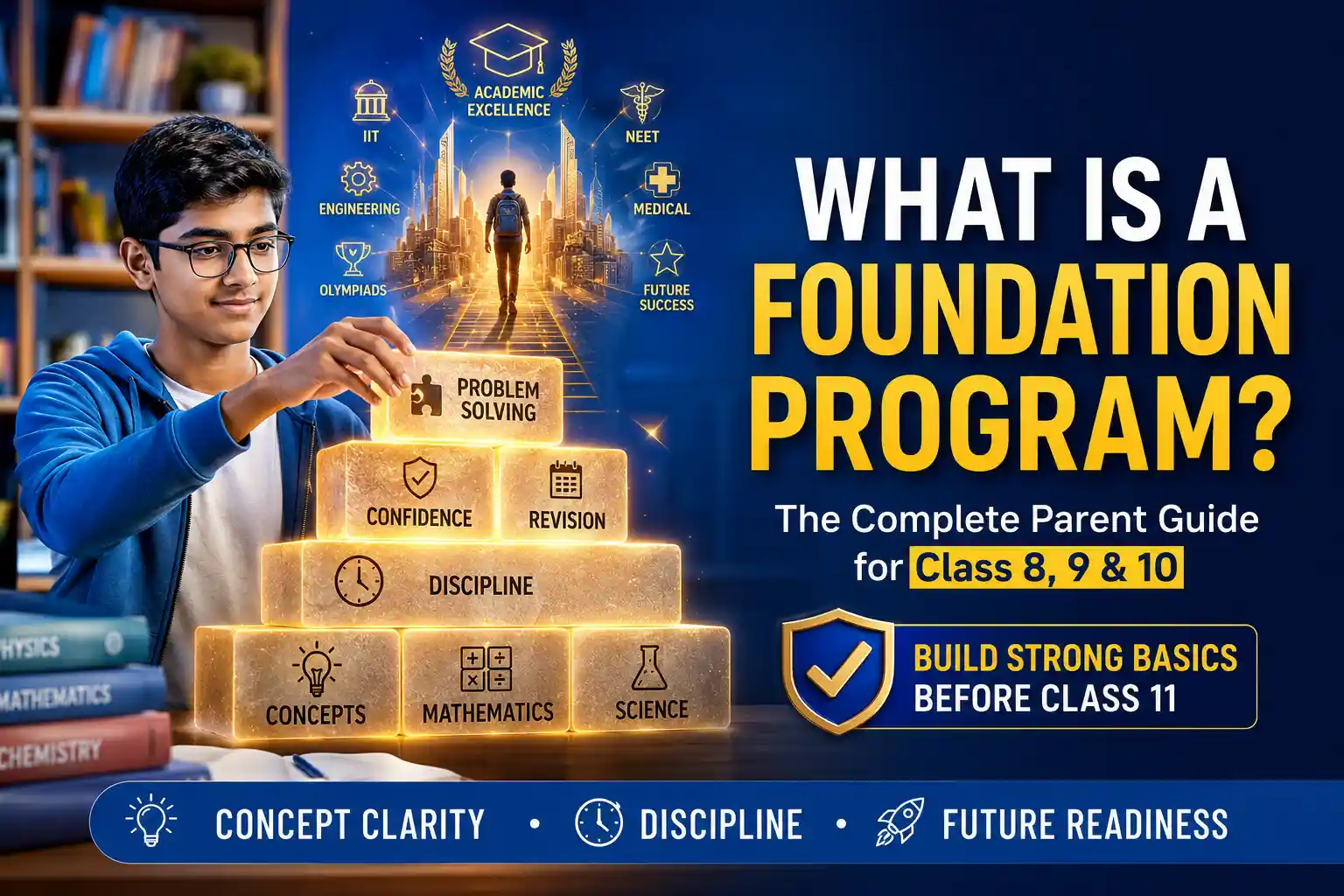
A foundation program is a structured learning system that helps students build strong basics, concept clarity, and study habits before school pressure becomes harder to manage. Parents usually start looking for a foundation program when they notice that their child is studying regularly but still not improving in a stable way. The child may forget lessons quickly, repeat the same mistakes, or score average marks without real understanding.
This is where the foundation program meaning becomes important. It is not the same as tuition, because tuition usually supports current school performance, while a foundation program is designed to strengthen the learning base for long term academic readiness. That difference matters most in Class 8, Class 9, and Class 10, when revision discipline, concept clarity, and future readiness begin to shape the child’s next academic stage.
For example, a student may be doing fine in school but still struggle when a question changes format. Another student may study hard before tests but forget most of it within days. In both cases, the issue is often not effort. The issue is weak basics and a lack of structured learning support. A foundation course vs tuition comparison becomes useful here because parents need to decide whether the child needs help for today or a system that improves learning over time.
A good foundation program does not replace school. It supports school in a smarter way so the student learns better, remembers better, and becomes more consistent over time.
A foundation program helps students build the base they need before the syllabus becomes more demanding.
What a foundation program means in simple terms
A foundation program is a structured academic support system that helps students build strong basics, concept clarity, and study habits before school pressure becomes harder to manage. It is designed to strengthen learning at the base level, so students can understand subjects more clearly and perform more consistently over time.
Unlike regular tuition, which usually focuses on finishing school lessons or improving current marks, a foundation program works on the deeper learning process. It helps students understand concepts, remember them better, and apply them in new questions instead of only memorizing answers.
For example, a student may complete homework regularly but still struggle when the same idea appears in a different form in an exam. Another student may study hard before tests but forget the lesson soon after. In both cases, the issue is often weak basics, not lack of effort.
A foundation program is useful because it builds long-term academic readiness. It helps students become more confident, more organized, and more stable in subjects that need regular practice and clear understanding.
A foundation program is not just extra class time; it is a system for building stronger learning from the ground up.
What Students Actually Learn
In a foundation program, students learn more than school syllabus support. They build subject understanding, practice problem solving, improve revision habits, and learn how to study with more structure. The real goal is to make school subjects easier to understand now so that harder competitive topics do not feel sudden later.
For Class 8, the focus is on basic maths, science thinking, and early habit building. Class 9, the work becomes more serious because students need stronger concept clarity in Physics, Chemistry, Math, and Biology. For Class 10, the focus shifts to weak area correction, board support, and readiness for the Class 10 to Class 11 jump. This is where a foundation course for class 8 9 10 becomes useful because it creates steady academic growth instead of last minute pressure.
Students also learn how to handle NCERT-based foundation work properly. That means understanding the lesson, applying it in questions, and revising it in a smarter way. It is not only about marks. It is about building the kind of base that supports future competitive exam prep and stronger confidence in school subjects.
What a foundation program usually includes
A good foundation program usually includes concept teaching, regular testing, doubt solving, weak-area correction, revision support, and progress tracking. Some programs also stay closely aligned with the school syllabus, especially for students in Class 8, Class 9, and Class 10.
The main goal is not to move fast through lessons. The main goal is to make sure the student actually understands what is being taught and can use that knowledge confidently later. That is what makes a foundation program different from ordinary short-term support.
Read More: Foundation Course vs Tuition for Class 9: Which Option Fits a Bridge-Year Student Best?
How a foundation program is different from tuition
A foundation program is different from tuition because it focuses on building long-term learning strength, not just helping a student get through the current school syllabus. Tuition usually supports homework, classwork, and exam preparation, while a foundation program works on concept clarity, revision habits, and problem-solving ability from the ground up.
This difference matters because many students do not struggle only with marks. They struggle with weak basics, low confidence, and poor retention. Tuition may help a student stay current with school lessons, but a foundation program is meant to improve how the student learns, remembers, and applies knowledge over time.
For example, if a student cannot solve a slightly different version of the same question in an exam, tuition may only help by explaining that question again. A foundation program looks deeper and checks whether the student actually understands the concept behind it. That is why parents often compare foundation course vs tuition when they want more than short-term score improvement.
Another key difference is pace. Tuition often follows the school’s immediate needs, while a foundation program is more structured and future-focused. It gives students time to revisit weak areas, reinforce basics, and develop academic discipline that supports later classes as well.
Tuition helps with today’s schoolwork, while a foundation program prepares the student for stronger learning in the future.
Read More: Foundation Course for Class 8, 9 and 10: Which Year Should Your Child Start?
Who should choose a foundation program
A foundation program is a good choice for students who need stronger basics, better concept clarity, and more structured study support. It is especially useful for students who are studying regularly but still not improving in a stable way, because the real issue is often weak understanding rather than lack of effort.
This option is often best for students in Class 8, Class 9, and Class 10, when school subjects start becoming more demanding and future readiness starts to matter more. Parents usually choose a foundation program when they want their child to build confidence, reduce repeated mistakes, and develop stronger revision habits over time.
It is also a smart choice for students who forget lessons quickly, struggle with applying concepts in new questions, or need repeated support before tests. In these cases, regular tuition may not be enough because the child needs a deeper academic base, not just short-term help with schoolwork.
A foundation program can also help students who are average performers but have the potential to improve significantly with the right system. It gives them a more disciplined learning path, which can make school performance more stable and prepare them for higher classes more confidently.
Students who need stronger basics, clearer concepts, and long-term academic readiness should choose a foundation program.
Read More: Class 8 Foundation Course vs Tuition: Which One Helps Build Strong Basics Faster?
When a foundation program is not the right fit
A foundation program is not the right fit when a student only needs quick homework help or short-term exam support. In that case, regular tuition or focused doubt clearing may be enough, because the child does not need a full learning system built from the ground up.
It is also not the best option if the student is already very strong in basics and only needs exam practice, speed building, or revision before a test. A foundation program is meant to strengthen concept clarity and study habits over time, so it may feel unnecessary for students who already have a stable academic base.
Some students may also struggle with a more structured setup if they are looking only for light support without regular testing, discipline, or long-term improvement. Since a foundation program requires consistent effort, it works best for students and parents who want steady progress rather than instant results.
A foundation program is not ideal for short-term needs; it is best for students who need deeper academic support and long-term learning strength.
Foundation program vs tuition comparison table
A foundation program is a stronger fit when the goal is long-term learning growth, while tuition is more suitable when the goal is immediate school help. This comparison is useful because many parents use both terms loosely, even though the two serve different purposes.
Foundation program vs tuition is not about which is better overall; it is about which one matches the child’s current learning need.
How parents can decide in 5 minutes
Parents can decide in 5 minutes by checking the child’s current need, not by comparing labels. If the child needs stronger basics, concept clarity, and long-term academic readiness, a foundation program is usually the better fit; if the child mainly needs homework help or short-term school support, tuition is often enough.
5-minute decision check
- If the child understands lessons slowly but forgets them quickly, lean toward a foundation program.
- If the child is keeping up with school but needs help finishing tasks or preparing for tests, tuition may be enough.
- If repeated mistakes show weak basics, choose the option that builds fundamentals.
- If the goal is immediate mark support, choose the option that focuses on current schoolwork.
- If you want long-term improvement in study habits and problem solving, choose the more structured learning path.
Quick rule: choose a foundation program for long-term learning growth, and choose tuition for short-term school help.
When Should a Student Start Foundation Preparation
The right time depends on the student, but the usual answer is simple. Foundation learning can start in Class 8, continue strongly in Class 9, and still help in Class 10. The earlier a student starts, the more time they have to build strong basics without pressure.
This is where the long-tail keyword what is a foundation program for class 8 9 10 fits naturally because the program is meant for these school years. A Class 8 student can use it to build habits and curiosity. Class 9 student can use it to strengthen concept clarity and adjust to more serious learning and Class 10 student can use it to fix weak areas before the jump into Class 11. That is why when should a student start foundation preparation is not a question with only one answer. It depends on how much support and structure the student needs.
For many families, the answer becomes clearer when they think about timing, not just marks. If a child needs better understanding, better discipline, and better readiness for later exams, then starting earlier usually makes more sense than waiting. That is also why a foundation program for school students works best as a long term support system, not a last minute fix.
FAQs
Is a foundation program better than tuition?
A foundation program is better when the child needs strong basics, concept clarity, and long-term academic growth. Tuition is better when the child mainly needs help with current school lessons or short-term exam support.
Who should join a foundation program?
Students who are weak in basics, forget lessons quickly, repeat mistakes, or need more structured learning support should join a foundation program. It is especially useful for Class 8, Class 9, and Class 10 students.
Can tuition and foundation programs work together?
Yes, they can work together if the child needs both current school support and deeper learning improvement. In that case, tuition can handle immediate academic needs while a foundation program builds stronger fundamentals.
When is a foundation program not needed?
A foundation program is usually not needed when the student already has strong basics and only needs light revision or occasional doubt clearing. In those cases, regular tuition or self-study support may be enough.
How do parents choose quickly?
Parents should look at the child’s real need: weak basics and long-term improvement point to a foundation program, while short-term homework or exam help points to tuition.
A foundation program is for building learning strength, while tuition is for immediate academic support.
Final recommendation
Choose a foundation program if your child needs stronger basics, clearer concepts, better study habits, and long-term academic readiness. Choose tuition if the main need is short-term help with schoolwork, homework, or exam preparation.
For parents deciding between foundation course vs tuition, the best choice depends on the child’s real learning gap. If the child keeps forgetting lessons, makes repeated mistakes, or struggles with new questions, a foundation program is the better fit. If the child is already doing well and only needs immediate support, tuition is usually enough.
Final recommendation: pick the option that matches the child’s learning need, not just the option that feels more common.